
As the data center industry hurtles toward higher density, tighter SLAs, and AI-scale workloads, one truth remains unchanged: when power fails, everything else stops. According to the Uptime Institute’s July 2025 Resiliency Survey, while only 28% of data center operators experienced a serious power-related outage in the past three years, power events remain uniquely disruptive. As Andy Lawrence, Uptime’s Executive Director of Research, puts it:
“When the power does go out in a data center, nothing else works.”
And that’s the point. Unlike network glitches or isolated hardware failures, a power loss is absolute. It immediately puts operations, availability, customer confidence, and reputational integrity at risk.
So while the frequency of power-related incidents may be relatively low, their potential impact is what keeps operators and executives up at night—and rightly so.
Power System Redundancy: Still the First Line of Defense
The 2025 report reinforces a foundational principle: resiliency in the power chain is the single most effective method of avoiding downtime. In fact, 71% of respondents who avoided a power-related outage credit this to redundant power systems.
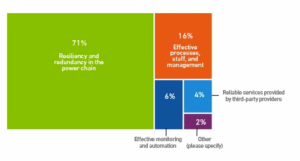
That means dual feeds, parallel UPS systems, transfer switches, and—critically—backup power generation.
“Redundant designs help ensure that a single failure doesn’t cause an outage,” Lawrence explains. “By duplicating critical components like UPS systems and backup generators, data centers are usually able to maintain operations even during grid or equipment failures.”
This is particularly important as power reliability becomes less of a given. Grid strain is increasing, AI clusters are spiking energy demand, and regions like ERCOT (Texas) are instituting mandatory load curtailment protocols. In this environment, redundancy isn’t a luxury—it’s the baseline.
Power Demand Management: An Emerging Vector for Resilience
A growing number of operators are also looking to demand-side energy strategies as part of their resiliency toolkit. One in four (26%) of survey respondents participate in a power demand management program today, with another 22% planning to join in the future.
The mechanisms vary. Some shift workloads across regions. But more notably, 49% of participating operators use on-site generators to shed load during high-demand events, supplying power back to the utility or at least minimizing draw during peak stress windows.
That’s a significant shift. Generators are no longer just passive insurance policies—they’re active tools in grid stabilization strategies. This role as both a resiliency measure and a grid asset puts a new spotlight on generator reliability, configurability, and ease of integration.
Interestingly, 36% of demand response participants reduce IT load to meet program thresholds. This figure is higher than expected and indicates that many data centers still lack the infrastructure—or confidence—to rely on backup generation when needed. That gap presents a risk, and an opportunity for modernization.
Generator Usage Isn’t Theoretical – It’s Happening
While some industry voices continue to question the long-term viability of diesel-based backup systems, the data doesn’t lie: 65% of respondents reported using their backup emergency generators in the past year to keep the facility running during a power disruption or instability event.
These aren’t minor blips. These are real-world activations to maintain uptime during grid events—exactly what generators are designed for.
Lawrence notes:
“Generators aren’t there to perform a theoretical role. Rather, they are commonly being used to prevent the loss of power.”
The real-world takeaway? Backup power generation is being used—and used often. And with regulators increasingly focusing on carbon emissions and sustainability metrics, the smart move isn’t to ditch backup generation, but to modernize it: higher efficiency engines, cleaner fuel mixes, and improved emissions controls are all part of the equation.
The Case for Rethinking Your Backup Power Strategy
What does all this add up to? A clear and urgent need for operators to evaluate their backup power generation posture with fresh eyes.
This is not just about compliance or ticking boxes. It’s about building a power strategy that is resilient under load, responsive to utility demands, and robust enough to engage during real-world events. Whether your facility is in a dense metro, a developing grid region, or part of a distributed edge strategy, your power continuity plan will define your reliability reputation.
For sophisticated operators, this means investing in systems that go beyond basic redundancy. It means sourcing generators that can handle sustained loads, spin up quickly, integrate with SCADA and BMS systems, and support participation in demand response or microgrid configurations.
It also means working with partners who understand the difference between selling equipment and engineering resilience.
How Network Environments Can Help
At Network Environments, we don’t just sell generator sets – we help data center operators design and deploy reliable, scalable, and compliance-ready backup power systems that work in the real world. Whether you’re building a new facility, retrofitting for higher density, or preparing to participate in a demand management program, our team has the engineering expertise and supply chain agility to help.
We offer a range of diesel and alternative-fuel generator solutions – many built around high-performance, low-emission engines like those from Baudouin – and we support every installation with technical design, logistics planning, and ongoing service options.
Power continuity isn’t an abstract goal. It’s a critical function that needs to work, every time.
To discuss how Network Environments can help support your facility’s uptime objectives, Schedule a call with our team today.